
Golf Problem #47: Sunglasses Make You Worse at Golf
Here’s a problem almost every golfer has, and almost nobody talks about.
You tee off into a bright sky, so you put on your sunglasses. By the second hole you’re squinting through lenses that flatten the world into a two-dimensional poster. Every green looks like a flat green circle — no slopes, no tiers, no break. So you take them off to putt, your eyes can’t adjust for three holes, and by the back nine you’ve got a headache, a red-eyed squint, and no idea where your ball landed.
Golfers have quietly accepted this. Squint through the front nine, blind yourself on the greens, repeat.
Scheyden golf sunglasses entire pitch is that this is an equipment problem, not a golfer problem — and the company has an unusual résumé to back it up.
From the Cockpit to the Fairway
Scheyden golf sunglasses are made by West Coast Trends, Inc., the Huntington Beach, California company better known to golfers as Club Glove (the travel bag brand). The company has been building Japanese-made eyewear since 2000, and it built its reputation in general aviation — pilot sunglasses, where the bar for optical clarity, glare control, and instrument readability is unforgiving. Scheyden later moved into fishing, then Scheyden golf sunglasses.
The golf line wasn’t a re-badged pilot frame. According to GolfPass’s buying guide, Scheyden spent roughly six months testing lenses specifically to find tints that filter light while preserving the color fidelity a golfer needs to read green contours — before selling a single golf pair.
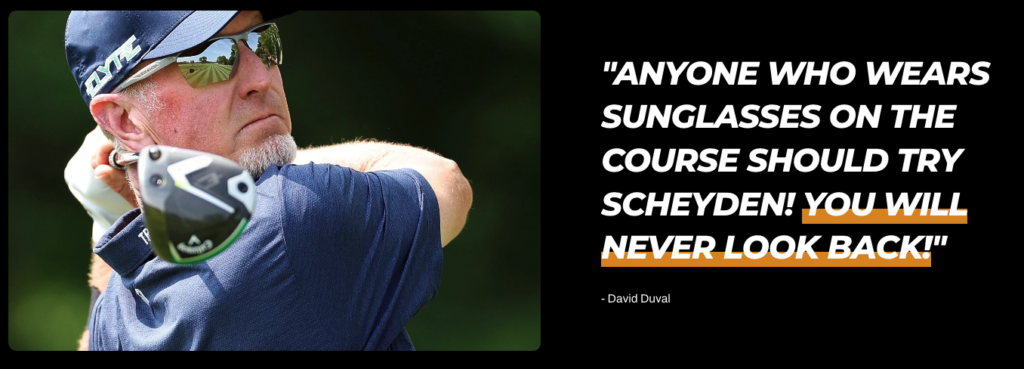
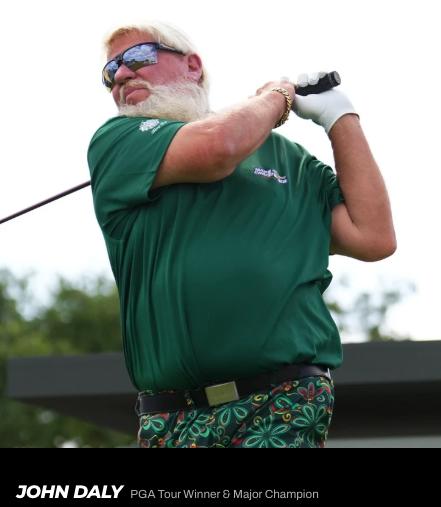
The result, per the brand, is that more PGA Tour Champions players have chosen Scheyden golf sunglasses-specific CIA eyewear than any other brand over a recent 30-month stretch, making it the #1 sunglass on that tour. (That’s Scheyden’s own claim, not a third-party ranking — but the tour presence is real: David Duval, who made wraparound shades a thing in the late ’90s, and John Daly are both Scheyden wearers.)
The Real Fix Is Lens Color, Not Lens Darkness
Most golfers shop sunglasses by darkness. That’s backwards.
Golf lenses live or die on color science. On the color wheel, red sits opposite green — which is why bronze, brown, and rose-family tints make green turf pop. They don’t just darken the scene; they build contrast between fairway, rough, green, and shadow, so undulations you’d normally miss become visible edges.
Scheyden golf sunglassesline runs on two bronze tints and nothing else. That’s the whole decision:
| Lens | Light Transmission (VLT) | Best For | What It Feels Like |
|---|---|---|---|
| LT16 Bronze | ~16% | Bright, full-sun days; golfers who already wear shades | Maximum glare defense without killing color; crisp, relaxed definition |
| LT33 Light Bronze | ~33% | Overcast days, early/late rounds, and golfers who “hate sunglasses” | A “naked eye” feel that works with the shadows instead of crushing them — and brightens your view in flat light |
Both lens options carry 100% UV protection, per Scheyden, and both are available polarized or non-polarized.
That LT33 option is the sleeper. In MyGolfSpy’s testing, the tester preferred the lighter LT33 even in very sunny conditions because it made reading greens easier — and said flatly that if there’s a higher-contrast golf lens out there, he hasn’t seen it. Plugged In Golf found the same thing from the other direction: at 33% transmission, greens’ shades were “distinctive,” subtle contours popped, and ball flight was easy to track.
Practical rule: if you play in the South or Southwest at midday, start with LT16. If you play in the morning, in shoulder season, or you’re a sunglasses-hater getting converted, start with LT33.
The Polarization Problem
You’ve probably heard “never wear polarized lenses for golf.” Here’s why that advice exists: polarization is tuned to knock out horizontal glare — reflections off water, car hoods, and wet asphalt. On a golf course, glare off grass and the sheen on a putting surface is exactly the visual information your brain uses to judge slope. Flatten that out and greens read like they’ve been run through a filter.
GolfPass’s guide is blunt about it: polarized lenses “flatten your field of vision, making it more difficult to see contours,” and their reviewer can’t play golf in them at all.
Scheyden’s answer is unusual for a premium eyewear brand — the choice is yours. Both mineral glass and RZR razor-sharp resin lenses can be spec’d polarized or non-polarized, so anglers get their glare-cutting polarization and golfers can choose the non-polarized build that keeps depth perception intact. If you play both, that matters.
The Lineup: Seven Frames, Two Lens Tints
The current Scheyden golf collection runs seven models:
| Model | Frame Style | Price |
|---|---|---|
| CIA Grabber | Half-rim sport wrap — the most popular golf model | $179 |
| Looper | Full-rim, more casual — the caddie favorite | $179 |
| CIA Panorama | Wide-coverage sport frame | $179 |
| Wingman | Sport wrap | $179 |
| Shirudo | Sport wrap | $179 |
| Gimme | Sport wrap | $179 |
| CIA Titanium | Full titanium construction, flagship build | $349 |
The CIA name stands for Confidence In Action — the frame family that launched Scheyden’s golf-specific line.
If you want the safest first pick, it’s the CIA Grabber: it’s the flagship, it’s the one the third-party testers keep ending up with, and its wrap geometry holds position through the torque of a full swing. If you want something that looks like a lifestyle frame but performs like a sport one, the Looper is the pick — GolfPass’s reviewer preferred it, and noted it’s what you’ll see on the heads of tour caddies.
Five Hours of Comfort Is a Performance Feature
You wear golf sunglasses for the length of a round — often longer in a cart — so fit is not cosmetic.
Scheyden builds frames in titanium, TR90 composite, and titanium/TR90 hybrids, engineered to aerospace-style tolerances and manufactured in Japan. The details that matter on the course:
- Adjustable silicone nose pads and temple tips — so the frame can be tuned to your face instead of sliding down your nose mid-backswing
- Lightweight, balanced frames — the fatigue argument is real; a few grams over 18 holes is the difference between forgetting your shades and resenting them
- Frameless or open bottoms on the sport models — the contour of the lens, with no frame at the bottom or sides, keeps your field of view clean when you’re standing tall over a driver or crouched over a five-footer
- Scratch- and smudge-resistant coatings — you will touch these lenses, repeatedly
Plugged In Golf’s reviewer summed up the fit as a blend of “golf-centric performance and country club looks,” with an unobstructed view in every posture. Prescription Rx lenses are available on request.
What the Reviews Actually Say
| Source | Verdict |
|---|---|
| MyGolfSpy (“We Tried It”) | Best-in-class contrast; bronze tint brings green hues “to life”; called out composite-frame pricing as a hard swallow and wanted more rubber on the arms for sweaty rounds |
| Plugged In Golf | “Optics are as good as I’ve encountered”; frame quality exudes quality; lens color “excellent for reading the contours of the fairways and greens” |
| GolfPass | Named Scheyden its “favorite mid-range option”; highlighted hand-made-in-Japan build quality and the six months of golf-specific lens testing |
The consistent throughline: nobody argues about the lenses. The debate is about value — a composite frame with resin lenses at $179 competes against $90–$600 options in a crowded category.
Who Should Buy Scheyden — and Who Shouldn’t
Buy them if:
- You’ve stopped wearing sunglasses on the course because they wreck your depth perception
- You want one lens tint that makes contours readable instead of a dark filter you fight all day
- You play in variable light and need a lens that doesn’t go black in the shade
- You want Japanese-made build quality without hitting the $400+ tier
Skip them if:
- You’re shopping on price — there are perfectly good $50–$90 golf-specific lenses
- You want a fashion-forward statement frame; Scheyden’s golf line is deliberately understated
- You need full polarization for fishing or driving and want one pair to do everything (though you can spec polarized)
- You sweat heavily and want maximum grippy rubber down the temples — reviewers flagged this
How to Choose Your Pair
- Match the lens to your light, not to your wardrobe. LT16 for sun-belt midday golf, LT33 for everything else.
- Decide polarization by primary use. Non-polarized for pure golf; polarized if fishing or water sports dominate.
- Pick the frame by swing and style. Wrap-style (Grabber, Panorama, Wingman, Shirudo, Gimme) for a locked-in sport fit; full-rim (Looper) for a more everyday look; titanium (CIA Titanium) for the lightest, longest-lasting build.
- Use the guarantee. Scheyden backs the golf line with a 30-day “See Better, Play Better” guarantee — meaning you can play several rounds in them and still return them if the tint isn’t right. That’s the single best way to answer “LT16 or LT33?” for your own eyes.
- Get Rx if you need it. Prescription lenses are available on request, so you’re not layering sunglasses over your everyday glasses.
FAQ
Do Scheyden golf sunglasses come with polarized lenses? Both options exist. Lenses can be ordered polarized or non-polarized, in either mineral glass or RZR resin. For pure golf, non-polarized is generally the better choice for green reading.
What does LT16 and LT33 mean? It’s the visible light transmission percentage. LT16 lets 16% of light through (dark; bright days). LT33 lets 33% through (lighter; low light and golfers who don’t normally wear sunglasses).
Are Scheyden sunglasses worth the price? Third-party reviewers rate the lenses at or near the top of the category. The value question is about the frames — composite and titanium frames with Japanese manufacturing, priced from $179 to $349.
Can I read greens while wearing them? That’s the entire design brief. Bronze tints maximize green contrast, and non-polarized lenses preserve the depth cues polarization removes. Reviewers reported no green-reading penalty.
Where are Scheyden sunglasses made? Japan, by West Coast Trends, Inc. of Huntington Beach, California — the company behind Club Glove.
The Bottom Line
Most golf sunglasses are lifestyle sunglasses that happen to be worn on a course. Scheyden’s are the opposite: an aviation optics company that spent months engineering a bronze tint for reading turf, then wrapped it in frames light enough to forget by the 14th hole.
The problem the brand actually solves isn’t glare. It’s the reason you take your sunglasses off to putt — and then can’t see anything for three holes. If you’ve been playing blind all summer because of it, that’s a golf problem with a $179 fix.