
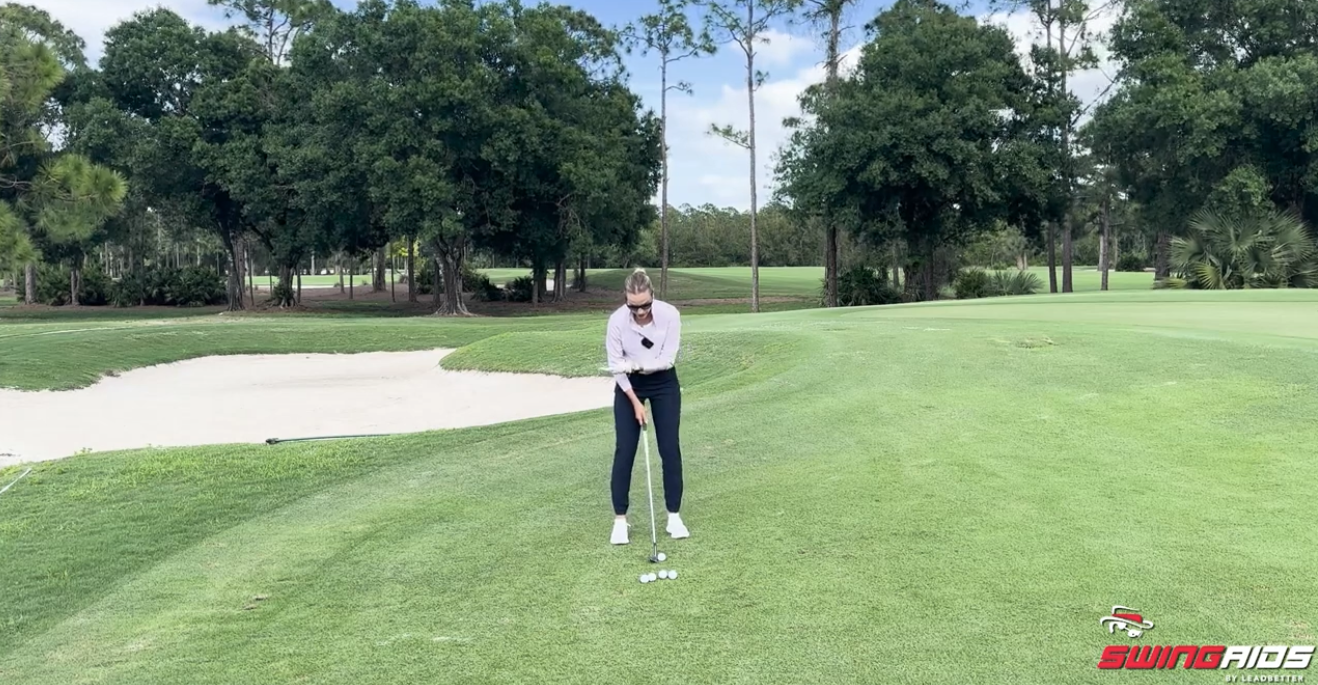
Miss a green and immediately think “please don’t chunk it”? A Leadbetter-certified coach breaks down the setup fix, the body motion, and the old-school training aid that gets the ball up soft and close.
By Golf Problems Staff · September 30, 2026 · Instruction · 4 min read (plus a 5-minute video)
Video: “The key factor to hitting high soft shots around the greens!” — Caroline Pinegar, Leadbetter Swing Aids on YouTube. If the embed won’t play in your reader, watch it on YouTube.
The shot that costs you the most strokes
You know the one. You’ve just missed the green, the ball is nestled down in the fringe or the first cut of rough, there’s barely any putting surface to work with and the grass is growing into you. You can feel the chunk coming before you even take the club back.
That’s exactly the shot Caroline Pinegar, a Leadbetter-certified instructor, breaks down in the video above from the Leadbetter Swing Aids channel. Her opening point should get your attention: this is where scores are made or lost, and most amateurs struggle around the greens because they set up to dig instead of setting up to use the loft the wedge already has.
Her target for you: get so comfortable over this shot that you expect to get up and down 80 or 90 percent of the time. Here’s how she says to get there three fixes you can take to the practice green tomorrow.
Why you keep chunking it
Before the fixes, the diagnosis. The chunk isn’t bad luck it’s your setup asking the club to dig. Pinegar sees three compounding mistakes every day:
- The ball is too far back in your stance. Most golfers move it back because they want to hit down on the ball. Then they hit down a little too much and the leading edge digs.
- Too much weight on the lead foot. Extra forward lean steepens the strike even more and emphasizes the dig.
- The wedge makes it worse. With a 56° or 60° in your hands, a dig gets ugly fast. Into the grain grass growing toward you the turf catches the club and, in her word, you chunk it.
Fix No. 1
Play the ball at your lead ear
For a high, soft chip out of this lie, move the ball up. Pinegar lines it up level with her lead ear left ear if you’re right-handed which puts it just forward of center.
- Ball at lead-ear level, slightly forward of center
- Hands stacked just above the ball not pressed way ahead, not dropped behind
- Weight about 60/40 onto the lead foot forward, but not slammed
That setup does two things: it keeps the leading edge from digging, and it lets the 60° (or 56°) do what you bought it for throw the ball up in the air using its natural loft.
Fix No. 2
Your core is the engine — not your arms
This is the big one. Most amateurs chip with their arms: the hands and arms flap back and through while the body stands still, completely disconnected. That’s how you get steery, stabby contact.
Pinegar wants the belly button doing the driving. The core turns back, the core turns through, and the arms stay connected to your chest the entire way connected going back, connected going through. It’s David Leadbetter’s oldest line, and it fits this shot perfectly:
“It is not arm action. The dog wags the tail, not the tail wags the dog.”— David Leadbetter
Your core is the dog. Your arms are the tail. Let the tail lead and you’ll thin it, chunk it, or scoop it — sometimes all three in the same round.
Fix No. 3
The Boomerang makes the connection automatic
For practice, Pinegar reaches for the Leadbetter Boomerang her words, “an oldie but a goodie” that still works as well as anything out there for this exact feel.
- Slide the Boomerang under your lead arm so it wedges between your upper arm and your chest
- Set up exactly like Fix No. 1 ball at lead-ear level, hands just above the ball, weight 60/40
- Chip while keeping pressure between your chest and lead arm going back and through
The feedback is instant: if the Boomerang drops out, you got armsy and your hands took over. Keep it pinned and the club has no choice but to move with your body which forces the core-driven, accelerating strike that launches the ball high and lands it soft.
Her verdict after hitting chips with it in the video: high, soft, and “a tap-in you can hit all day long.”
Your pre-round chipping checklist
Run this list at the practice green until it’s automatic:
- Ball at lead-ear level, just forward of center
- Hands just above the ball
- Weight 60/40 on the lead foot
- Belly button turns back, belly button turns through
- Arms connected to your chest the entire time
- Accelerate through impact — never stab at it
The bottom line
You don’t need a new swing to fix your chipping you need a setup and a body motion that stop asking the leading edge to dig. Move the ball to your lead ear, let your core wag the tail, and use the Boomerang under your lead arm to make the connection automatic. Then take the aid away and hit a few more; the feel should carry over immediately.
One honest note, since that’s the house rule here: the video comes from the Leadbetter Swing Aids YouTube channel, and the Boomerang is their product if you want one. The setup and the core-driven motion cost nothing. They start with where you put the ball in your stance.