
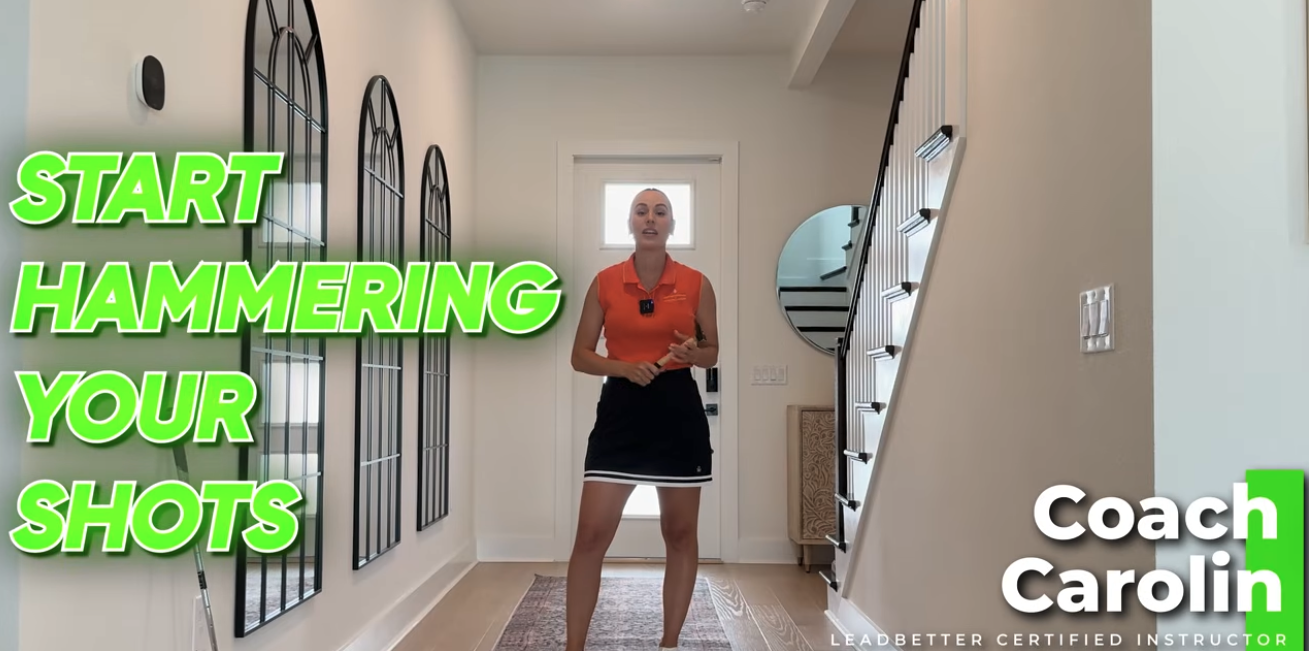
If your swing feels weak, inconsistent, or impossible to time, the problem may not be your tempo. It may not even be your backswing. It might start with something much simpler: how your trail hand works on the club.
In this lesson, Coach Carolin uses a surprisingly simple comparison—a hammer—to show golfers why so many swings lose power before the club ever gets moving. And once you see it, it makes a lot of sense.
The Problem: A Trail Hand That Looks Fine, But Doesn’t Work
A lot of golfers hold the club in a way that looks normal at address but makes it much harder to use the right wrist properly in the swing. The result is a motion that gets dominated by the trail elbow while the wrist stays too passive.
That matters because if the wrist never really sets, you lose leverage. And when you lose leverage, you usually lose the three things every golfer is chasing: speed, solid contact, and face control.
Coach Carolin’s point is simple: if your right arm is doing all the work and your wrist isn’t helping, you’re making the swing harder than it needs to be.
Why the Hammer Feel Works
Think about how you would naturally hold a hammer if you were about to drive a nail. You wouldn’t grip it in a soft, disconnected way. Your hand would sit in a position that lets your wrist and elbow work together to create force.
That’s the feel Carolin wants golfers to bring into the swing.
Instead of thinking about making a pretty golf motion, she wants players to feel athletic and functional. A hammering motion creates structure in the trail hand, helps the wrist set more naturally, and gives the club a better chance to load and release with speed.
What Most Golfers Get Wrong
According to Carolin, many players grip the club in a way that isolates the trail wrist. When that happens, the club gets lifted more by the arms than loaded by the hands and wrists. That can make the backswing look okay on camera, but it usually costs power and consistency where it matters most.
The biggest red flag is when the golfer bends the trail elbow without creating the proper wrist angle. In other words, the club moves, but the leverage never really builds.
If that sounds familiar, it may also explain why your longer clubs don’t go as far as they should—or why your driver doesn’t separate enough from your irons.
The Feel You Want Instead
Carolin suggests feeling like the club is something you could actually hammer into the ground. That image encourages the trail hand to get into a stronger, more useful position on top of the grip rather than sliding too far to the side in a weaker setup.
She also uses another useful image: imagine the grip is wrapped in a wet towel and you’re trying to wring the water out. That feeling of opposing pressure helps both hands work together and puts more functional pressure into the handle.
For a lot of golfers, that one feel can instantly change how the club sets during the takeaway and into the backswing.
A Simple Drill to Try at Home or on the Range
One of the best parts of this lesson is that it gives you a clear checkpoint. Carolin wants golfers to get the club to about halfway back and make sure the wrist is actually setting. From there, the shoulders can keep turning while the club continues into a stronger position instead of getting dragged behind the body.
If the clubhead stays too low or the wrist never loads, you’re probably still making the same old move.
This is the kind of drill that’s easy to rehearse at home without even hitting balls. And honestly, that’s probably the best place to start if your grip has been the same for years.
Why This Matters More Than Most Golfers Think
Grip changes are never glamorous, but they’re often the fastest route to better golf. A poor grip can block speed, wreck sequencing, and force compensations all the way through impact. A better grip can make the swing feel more natural almost immediately.
That’s really the takeaway here. This isn’t just a random drill. It’s a way to train your hands and wrists to support the swing instead of fighting it.
And if your ball striking has felt weak, awkward, or unreliable lately, this might be one of the most useful feels you can steal.
Final Thoughts
There’s a reason simple analogies work so well in golf instruction. The body often understands a task faster than it understands a technical explanation. In this case, “swing like you’re hammering” may be a better cue than a dozen mechanical thoughts.
Coach Carolin’s lesson is a good reminder that real speed and solid contact don’t always come from swinging harder. Sometimes they come from finally putting your hands on the club in a way that lets the swing work.
1 Comment
The Hammer Drill is more effective when used for the LEAD wrist and arm !!