
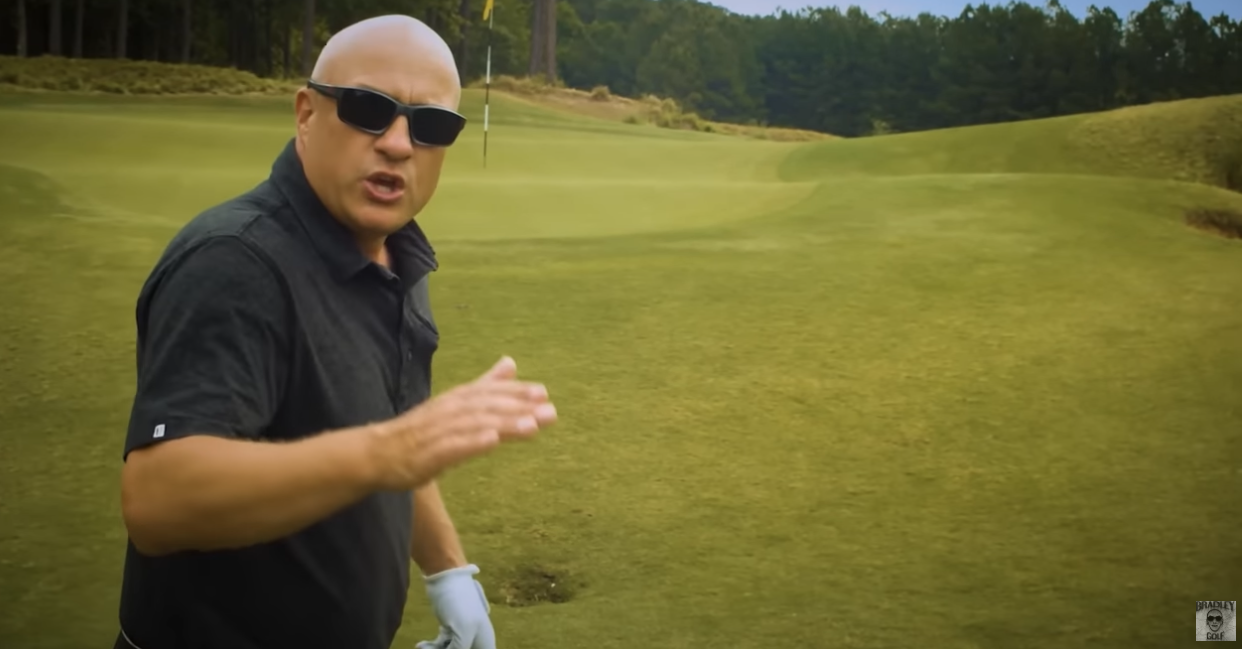
If you struggle with awkward chips around the green, you’re not alone. One of the biggest problems amateur golfers face is knowing exactly where to land the ball and how far it will run after it hits the ground. In this short lesson, Nick Bradley Golf shares a simple concept that can make chipping feel much more predictable: the 2 Bounce Rule. Source
What Is the 2 Bounce Rule
Bradley explains the shot like a traditional bump-and-run, the kind of low-running short-game play often associated with links golf. The idea is simple: visualize the first bounce as 100%, the second bounce as 50%, and then expect the ball to roll out from there. That “half-life” pattern gives golfers an easy way to predict how the ball will behave once it lands. Source
Instead of obsessing over perfect technique, this rule gives you a practical landing model. If your first bounce travels about four feet, your second bounce may travel about two feet, and then the ball releases. That kind of visualization can make difficult chip shots feel far less intimidating, especially when you’re working from the fringe or a tight fairway cut. Source
Why This Helps So Many Golfers
A lot of chipping problems come from poor visualization. Golfers often focus only on the hole, without building a clear picture of where the ball should first land and how it should react from there. The 2 Bounce Rule gives you a framework for that picture. Instead of guessing, you can begin to map the shot backwards from the landing area to the rollout. Source
That’s especially useful on those in-between shots where a standard pitch feels too risky, but a putter won’t work because of rough, slope, or distance. Bradley describes this type of shot as awkward for pitching, which is why using a controlled pitch-and-run with a bounce-and-release pattern can be such an effective option. Source
How to Use the Rule on the Course
The concept starts with choosing a landing spot well short of the hole. In the example from the video, Bradley lands the ball onto the fringe and lets the first bounce, second bounce, and release do the rest. The shot becomes less about hitting the ball at the pin and more about using the ground to feed the ball toward the hole. Source
This is a smart reminder for golfers who automatically reach for a lofted, high-flying chip every time they get near the green. In many situations, the safer and more consistent play is to keep the ball lower, land it earlier, and let it run. The better your understanding of that first and second bounce, the easier it becomes to control distance. Source
Use the Ground to Your Advantage
One of the best points in the video is Bradley’s advice to use the bank to your advantage. Too many amateur golfers ignore slopes and contours when they chip, even though those features can help guide the ball to the hole. A well-chosen landing spot on the fringe or slope can act like a funnel, turning a difficult up-and-down into a much simpler shot. Source
When you combine that awareness with the 2 Bounce Rule, you start to think more like a skilled short-game player. You’re no longer just trying to “hit a chip.” You’re planning how the ball lands, how it reacts, and how the ground can help it finish close. Source
A Better Way to Practice Chipping
If you want to test this for yourself, head to the practice green and experiment with different landing spots. Pick a spot on the fringe or just onto the green, then watch how far the first bounce carries, how much shorter the second bounce is, and how the ball releases after that. Over time, you’ll build a much better instinct for how chips behave with different clubs and different surfaces. Source
This kind of practice can be more valuable than simply hitting chip after chip without a plan. The goal is to train your eyes as much as your technique. Once you understand the bounce pattern, distance control becomes more natural. Source
Final Thoughts
The 2 Bounce Rule is a simple idea, but that’s exactly why it can be so powerful. It gives golfers a clearer picture of how a chip shot should behave, especially on those awkward shots where a high pitch feels unnecessary. If your chipping has been inconsistent, this could be the missing piece: stop guessing, start visualizing, and let the ground work for you. Source
For golfers trying to save strokes around the green, that’s a tip worth taking to the course. Source