
Everything you need to understand about the little white (or yellow, or matte pink) thing that makes the whole game go. These are the golf ball terms you should know as a golfer.
So… Why Does the Golf Ball Matter?
It might seem like all golf balls are the same. After all, they’re small, round, and usually white. But here’s the truth: the golf ball is the only piece of equipment you use on every single shot. It’s your constant companion, whether you’re piping a drive, finessing a wedge, or nervously lining up a 3-footer to save par.
And golf balls are definitely not all created equal. From how they’re built to how they spin, fly, and feel, there’s a lot going on beneath that dimpled surface. Understanding golf ball construction explained simply is the first step to lowering your scores.
Let’s walk through the key golf ball terms every golfer should know. This guide will help you pick the right one and actually understand what your playing partners are talking about when they say “I need more greenside spin” or “this ball feels clicky.”
Core Golf Ball Terms (Literally)
1. The Core: The Engine of the Ball
This is the innermost part of the golf ball. Think of it like the engine. Under USGA regulations, it is typically made from elastomeric materials (synthetic rubber) and is designed to maximize the Coefficient of Restitution (COR)—which is a fancy way of saying it helps with speed and energy transfer at impact.
Why it matters: A firmer core usually leads to higher ball speed and more distance, especially for faster swingers. A softer core often feels better and can help reduce spin off the driver, keeping your shots straighter.
2. Compression: How the Ball Reacts
This refers to how much the ball compresses against the clubface at impact. If you look at a golf ball compression chart, it is typically rated on a scale from 30 to 110.
- Low Compression (30 to 60): Softer feel, more forgiveness. These are often the best golf balls for beginners 2026 and those with slower swing speeds.
- Mid Compression (60 to 90): Balanced performance for the average golfer.
- High Compression (90 to 110): More control and speed potential for fast swing speeds.
“How does golf ball compression affect distance?” If your swing speed is slower, low compression golf balls for slow swing speeds can help you launch it higher and get more carry because you can fully activate the core. Faster swingers need firmer balls so they don’t “over-compress” and lose energy.
3. Layers (Construction): Building Performance
Golf balls come in different constructions: 2-piece, 3-piece, 4-piece, or even 5-piece designs.
- 2-piece: Simple and durable. Great for beginners who need distance and value.
- 3-piece: Adds a Mantle Layer between the core and cover for improved feel and control around the green.
- 4-piece or 5-piece: Offers the best blend of distance, spin separation, and feel. Preferred by skilled or high-swing-speed players.
“What is the difference between a 2-piece and 3-piece golf ball?” The 3-piece ball introduces that mantle layer, which allows manufacturers to tune the ball to spin less off the driver but spin more off a wedge.
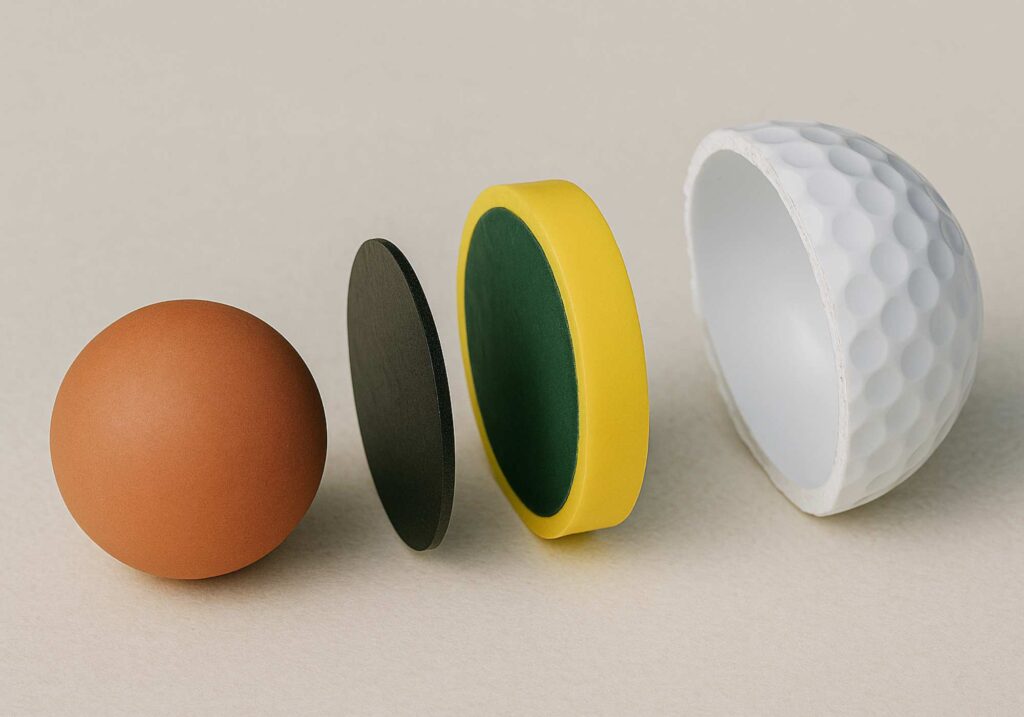
4. The Cover: Urethane vs Surlyn Golf Balls
The outer shell of the ball dictates feel and short-game performance. It is usually measured by its Shore D Hardness.
- Surlyn: Durable, lower cost, less spin. Found on most distance and value balls.
- Urethane: Softer feel, more spin on wedges and short shots. Used in premium tour balls.
“Does the cover of a golf ball matter for spin?” Absolutely. If you care about greenside control and soft feel, urethane is the way to go. But if you lose balls often, Surlyn might save your wallet.
5. Dimples: The Science of Flight
Those little indentations on the surface aren’t just for looks. “Why do golf balls have dimples?” They reduce aerodynamic drag & lift, helping the ball fly farther and more predictably. Without dimples, a golf ball would fly like a knuckleball and drop out of the sky much sooner.
Performance Terms You’ll Hear on the Course
Spin Rate
This measures how fast the ball spins in the air after impact. A proper golf ball spin rate guide will tell you:
- Driver spin: Lower is better for distance and fighting a slice.
- Wedge spin: Higher is better for stopping power on the green.
Launch Angle
How high the ball comes off the face at impact. A low-launch ball will flight lower and roll more, while a high-launch ball will carry farther and stop quicker.
Feel
A subjective but crucial term. “Feel” refers to the sensation at impact. A soft feel is preferred on putts, while a firm feel often provides more feedback on full swings.
Common Golf Ball Categories
Distance Ball
Built to go far. Usually lower spin, harder Surlyn cover, and optimized for straight flight. Great for beginners and high-handicappers.
Tour Ball or Premium Ball
Used by pros and better amateurs. Higher compression, urethane cover, multi-layer design. Great for skilled players who want ultimate control.
Low-Spin Ball
Reduces side spin and backspin. Helps fight slices and maximize rollout off the tee.

So… Which Ball Should You Use?
“What is the best golf ball for my swing speed?” Here’s a quick cheat sheet:
| If you are… | Try a ball that… |
| Losing balls often | Is durable and affordable (2-piece Surlyn) |
| New to golf | Is soft, low compression |
| Swinging slow (under 90 mph) | Has low-mid compression |
| Needing more control around green | Has a urethane cover, mid/high spin |
| A confident striker chasing an edge | Is a Tour-level urethane ball |
Final Thoughts: Don’t Overthink It (Yet)
Golf balls are important, but you don’t need to drop $50 a dozen to enjoy the game. Start with something that fits your budget, feels good, and performs well enough. As your game grows, you can experiment and even get fit for a ball just like you would your clubs.
The goal is to find one that feels right, flies true, and gives you confidence from tee to green.
Got Questions or a Favorite Golf Ball?
Drop your comments below. Whether you love a cheap Surlyn two-piece or swear by a premium urethane ball, we’d love to hear why.
Related Reading: