
![An Honest Review of The TaylorMade Soft Response Golf Ball [2023]](https://golfworkoutprogram.com/wp-content/uploads/2023/07/taylormade-soft-response-review.png)

Updated on August 22, 2023
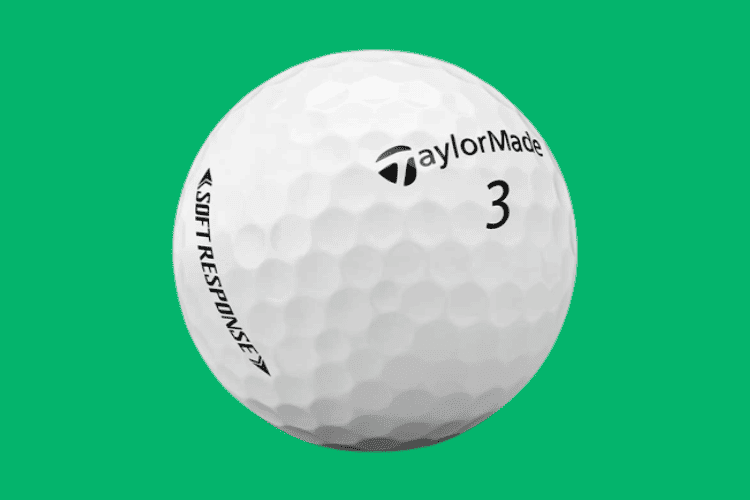
My review of TaylorMade Soft Response golf balls reveals the technology, performance, pros, and negatives of the design.
It was my first time testing these balls, and I liked what they delivered for my moderate swing speed. In fact, I’m considering playing it permanently.
I found it an easy ball to strike and launch, which other moderate and slow swing speed players will appreciate. After reading this review, you’ll know whether the soft, easy launching and affordable Soft Response suits your game’s distance, flight, and spin needs.


Features
Three-Piece Ball
It’s refreshing to see a 3-layer distance ball that delivers a superior greenside experience over its peers. The Soft Response comprises a low-compression core, a speed mantle layer, and an ionomer cover. An Extended Flight Dimple Pattern lines the ball cover for enhanced aerodynamics and consistent flight.
Lower Compression Core
The lower compression core was the star performer of the Soft Response. Its highly compressible design led to an enhanced energy transfer from clubface to ball, accelerating pace and minimizing spin. The combination prompted a high-launching shot for consistent carry distance.
I feel it’s ideal for moderate swing speed golfers battling to get the ball airborne. However, the elevated flight prompted a steep descent that resulted in a rapid stop on long shots reducing my roll and total length.
Soft Ionomer Cover
Soft and ionomer don’t typically match, but TaylorMade proves it’s possible. The ball felt soft in my hand, and that sensation was backed up when my clubface struck the ball. A pure feeling ensued on wood and iron strikes which was different from my experience with distance balls like the Callaway Warbird.
Besides its sensation, the ionomer cover proved effective in gripping into the grooves of my irons and wedges and raising the spin rate. Conversely, the cover helped to minimize spin and preserve ball speed on high-impact shots, encouraging enhanced rebound off the clubface.
Speed Mantle Layer
Contrary to most distance balls, TaylorMade inserted a middle layer between the low compression core and the soft ionomer cover. An ionomer Speed Mantle Layer works tirelessly to increase energy transfer and ball speed while restricting spin.
I produced consistent ball speed results thanks to a more effective rebound off the clubface on high-impact strikes.
Extended Flight Dimple Pattern
The Extended Flight Dimple Pattern excelled on takeoff and landing, obliterating drag as it left the clubface and enhancing lift on the descent. On takeoff, the aerodynamic dimples elevated the ball into the sky and propelled it forward for longer carry.
I welcomed the enhanced lift to delay my landing on long shots, optimizing my carry distance. However, the higher flight caused my ball to land rapidly, which reduced its total roll. The rapid landing of the Soft Response was a welcome feature on approach shots, enhancing my control.
Alignment Arrow
I found the alignment arrow small compared to the Distance +, but I still found it helpful when lining up putts. Golfers with visual impairments may find it challenging to decipher. However, it doesn’t impact the performance of the golf ball.
Packaging
I don’t typically mention packaging in my reviews, highlighting the impression it left on me. Besides the standard text listing the specs, TaylorMade applied visual aids to explain what impact each part of the ball has on your shot.
The core is represented by a 3D black dot, and visual illustrations surround it to highlight the purpose of the core, speed mantle, and dimple pattern.
For example, the design team shows a ball getting squashed from the side to represent the low-compression core. I also liked the image of a ball shooting forward to highlight the Hi-Spring Construction.
Colors
The Soft Response balls are available in 2 colors. My preference is always the tour white ball, but I appreciated the high visibility design of the yellow. It was an easy design to track in the air and spot in the thick rough.
I suggest golfers with visual impairments select the easier-to-follow yellow balls. There are no performance or price differences between the 2 options. It comes down to personal choice.

Performance
Price
A dozen Soft Response balls set me back $29.99, which places them at the higher end of the entry-level market. I’m happy to spend $2.50 on a soft ball that is easy to launch, feels smooth, and offers an element of spin.
They’re no Pro V1, but they are among the best distance balls I’ve tried for mid-handicappers. The construction is more complex than a traditional distance ball like the Titleist Velocity, leading to increased spin and control.
Feel
I welcomed the silky smooth feel of the TaylorMade Soft Response golf balls off the clubface. Different from the rock-solid sensation produced when I tested the Callaway Warbird. The soft feel is a product of the low 35 compression core, designed to maximize rebound off the clubface.
I particularly appreciated the softness of the feel on wedge shots and off the putter face. It gave me a clearer idea of how hard to strike the ball for better short-game distance control. The feel is further improved by the reformulated ionomer cover, which is softer than its peers.
The cover etched into the grooves of my short iron and wedge shots, increasing friction and boosting spin.
Sound
The acoustics proved clicky on strikes that came out the sweet spot on iron and wedge shots. Surprisingly, I produced a ‘thud’ on off-center strikes, my preferred acoustic. At least, the difference in sound provided the necessary feedback to identify where the ball struck the clubface.
The clicky noises continued with my flat stick, again, not my preferred audio. It did little to impact the performance of the ball, and it’s a personal preference. I know numerous mid-handicappers who appreciate clicky acoustics, and if you’re one of them, you’ll love the Soft Response.
High Compression
Despite its complex 3-piece construction, I found the Soft Response golf balls super easy to compress. The low, 35 compression core sprung off the clubface on high-impact strikes, conjuring up rampant velocity and minimal spin.
This combination prompted a hassle-free, towering launch, high ball flight, and a soft landing. Although the soft landing cost me total length, I welcomed the consistency of the launch and its strike ability.
Spin
Driver
My average spin rate with the big stick hovers around 2,500 rpm. The Soft Response exceeded the mark notching up an average of 2,830 rpm. It’s still suitable for generating a towering launch and consistent ball flight.
Ideally, I’d prefer a golf ball that spins lower and optimizes length. However, I welcomed the easy launching nature and consistent carry distance it produced.
Iron
The heightened spin rate continued into the middle irons as I exceeded my 7-iron average of 6,000 rpm by 650 rpm. I noticed the increased spin rate enabled my ball to bite faster on approach, enhancing my control.
Contrary to my experience with the Callaway Warbird, I found it marginally easier to hold tight greens with this ball. The added spin revolutions are a direct consequence of the softer, reformulated ionomer cover that bites into the grooves better.
Wedge
TaylorMade Soft Response golf balls seriously impressed on wedge shots. Obviously, they’re not in the league of a urethane tour ball, but for a soft golf ball, they spun more than I expected. On average, I notch up 9,500 rpm of pitching wedge backspin, but I generated 10,023 rpm during testing.
The difference between the TaylorMade Soft Response and distance balls like the Noodle Long And Soft is the cover. I felt TaylorMade produced a more reactive ionomer cover that spins hard on low-impact strikes.
Ball Speed
Driver
My driver ball speed averaged 137.8 mph, 4 mph below my fastest speed in 2023. I felt I lost some velocity at impact due to the higher spin rate and softer cover, but the results were still respectable.
I conjured up sufficient velocity to launch my ball consistently high and achieve satisfactory carry yardage off the tee.
Irons
Like my drives, I saw a drop in ball speed on 7-iron shots, leading to fewer yards than usual. I operated with an average of 113 mph, making it approximately 3 mph slower than my top speed.
The reduced ball speed and higher spin levels led to less total length. However, I was content with the results, given their consistency.
Distance
Driver
The Soft Response isn’t a particularly long golf ball. I produced superior yardage with the TaylorMade Tour Response, Warbird, and Noodle Long and Soft. I only generated 263 yards with the Soft Response owing to its higher launch, increased spin, and reduced roll.
Irons
My longest 7-iron shot with the Soft Response traveled 156 yards, but I averaged 149 yards on approach. These are in line with my standard 7-iron results, but I produced less roll with these TaylorMade golf balls compared to similar distance balls.
Instead of my average 5-yard roll average, the Soft Response golf balls produced 3.8 yards, highlighting the faster bite.
Launch and Flight
The easy-launching nature of the TaylorMade Soft Response golf balls was one of my favorite features. As an average golfer, I enjoyed having one less factor to worry about. Thanks to the rapid rebound off the clubface, the ball launched into the air with moderate spin and consistent velocity, resulting in an elevated launch.
Once airborne, the ball continued its mission to deliver a towering flight. My 7-iron sent the Soft Response 99 feet in the air, helping it carry trouble and land quickly and softly on the dancefloor. My apex was a foot higher than my average.
What I Like About The TaylorMade Soft Response
Soft Feel
The feel of the Soft Response golf balls impressed me, considering my experience with other firmer, distance golf balls. It produced a pleasant sensation off the clubface and felt soft in the hand. Its squashy feel stems from its lower compression core and soft ionomer cover to boost spring off the clubface and spin around the green.
Wedge Spin
The TaylorMade Soft Response balls don’t come close to a tour golf ball. However, they produce the best spin levels I’ve tried in a soft golf ball this year. The softer ionomer cover etched into the grooves of my wedges and imparted impressive backspin onto the ball.
High Compressibility
The increased compressibility on high-impact shots promotes an elevated launch, consistent ball speed, and controlled spin levels. The low compression core and Speed Mantle Layer enhanced my energy transfer from face to ball to boost speed, control spin, and promote an effortlessly high launch.
I feel the highly compressible, easy-launching design of the ball suits slow and moderate-swing-speed golfers.
Affordability
The affordability of the Soft Response balls is another welcome feature. It is more expensive than alternative distance balls, but they’re still significantly more affordable than premium TaylorMade balls like the TP5.
Although they’re priced higher than the Wilson Zip, Distance +, and Warbird, the Soft Response golf balls are still attractive to the average golfer.
High Visibility Yellow
I personally prefer using the standard white TaylorMade Soft Response golf balls because I’ve always played white models. However, I did enjoy the high-visibility yellow golf ball for its ease of traceability in the air. I feel it’s a valuable asset to golfers with visual impairments tired of losing sight of their ball in the sky or in the cabbage patch.
What I Dislike About The TaylorMade Soft Response
Loss of Distance
I lost almost 10 yards of driver distance with the TaylorMade Soft Response, owing to its increased long-game spin and moderate speed. The ball flew high but landed rapidly, costing me roll and total distance.
Clicky Acoustics
A challenge I experience with numerous distance balls is their clicky iron, wedge, and putter acoustics. I just find the sound irritating and prefer the solidness of a ‘thud’ noise when the clubface connects the golf ball. Acoustics won’t hamper your performance. It only boils down to your personal preference.
Overall Rating and Thoughts
My review of the TaylorMade Soft Response golf balls revealed an affordable, high-launching, soft landing distance ball for moderate swing speeds. It’s far from the longest golf ball I’ve struck, but I enjoyed the hassle-free launch, consistent carry distance, and rapid bite on approach.
Besides its long-game consistency, the Soft Response ball significantly impressed around the green. It produced ample friction and ball spin off my wedges to enhance my greenside control and short-game performance. Although slightly more expensive than other distance balls, they’re still affordable and ideal for moderate swing speed mid-handicappers.
Overall Score: 8.3/10
Matt Stevens
Matt Callcott-Stevens started playing golf at the age of 4 when Rory Sabattini’s father put a 7-iron and putter in his hand. He has experienced all the highs and lows the game can throw at you and has now settled down as a professional golf writer. He holds a Postgraduate in Sports Marketing and has played golf for 28 years. Current Handicap: 8