
The dominant story in the world of golf leading into the PGA Championship is the extreme uncertainty facing LIV Golf after the Saudi Arabia PIF announced it was pulling all funding after the end of the 2026 season.
The top concern for fans is whether that will finally bring the top players from LIV — most notably Bryson DeChambeau and Jon Rahm — back to the PGA Tour. DeChambeau will be the first to have that chance as he’s a free agent after this year, but he’s voiced his concerns about returning for a variety of reasons — including whether the Tour’s content creation policy would be a hindrance on his desire to continue building his YouTube channel.
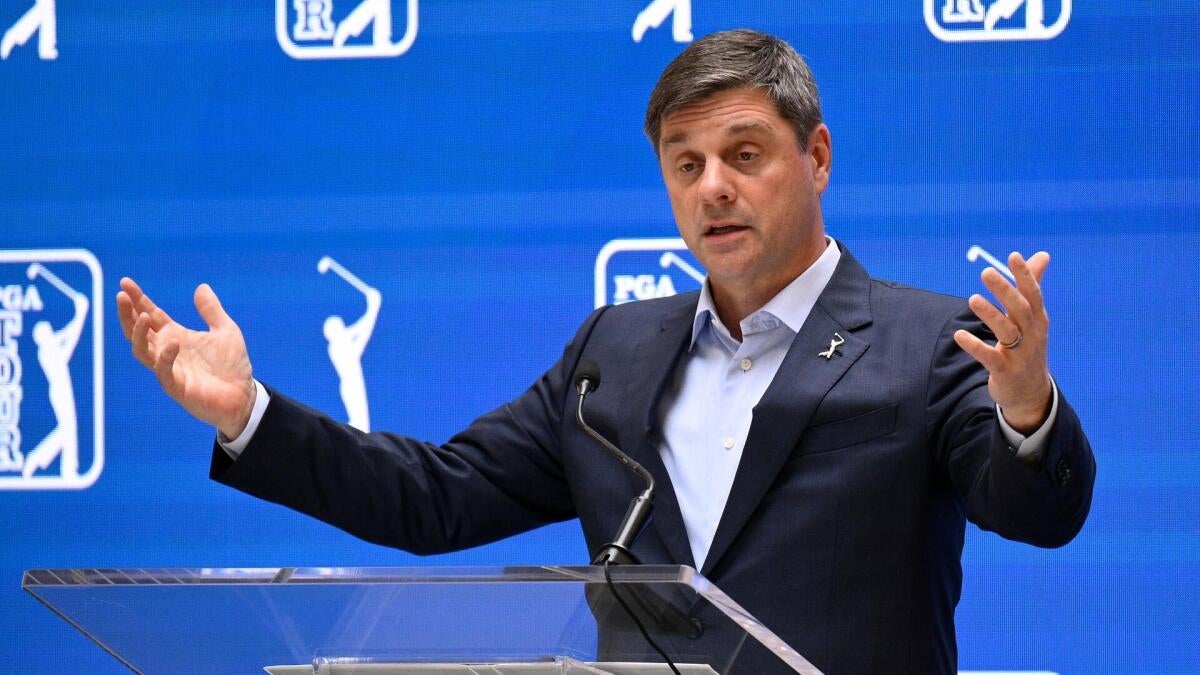
While everyone on the outside tries to figure out what the path back to the PGA Tour could look like for DeChambeau and Rahm, PGA Tour CEO Brian Rolapp is expressing a calm confidence about the Tour’s position with or without those two in the fold.
“The reality is all of their guys are under contract. Until they’re not under contract, it’s not really an issue we need to worry about,” Rolapp said on the Rich Eisen Show. “So we’re not spending a lot of time thinking about it, honestly. We’re spending most of our time on what you and I just talked about, about our future and how we make the Tour better.”
Rolapp understands that part of making the Tour better is having the best players competing as often as possible. That was a central theme of his plan for restructuring the PGA Tour’s schedule, aiming to have more Signature events that get the top players into fields on a more regular basis.
Earlier this year Rolapp laid out his six focal points he hoped to implement by 2028 with a revamped schedule that visits big markets more often, consistent field sizes of 120 players, a two-track system with promotion and relegation and an enhanced postseason. Tiger Woods was, prior to his latest DUI, heavily involved in that restructuring, and Rolapp seems to be trying to bridge the gap between what players and fans want out of the PGA Tour.
There is perhaps nowhere that divide is bigger than the issue of bringing back someone like DeChambeau, and Rolapp is aware of the balancing act required.
“[Fans] want to see the best golfers together as often as possible, and I agree with that. That’s great. I’ve always been very clear publicly that I’m interested in whatever makes the PGA Tour better,” Rolapp said. “But at the same time, there’s a reality we have a membership, and anything we do to make the PGA Tour better, we need to balance that with the interest of our current members. While I don’t have a lot of scar tissue of the past, it sort of still exists, and I have to be conscious of that.”
As much as his quote about “not spending a lot of time” thinking about LIV stars feels like a bit of bravado and bluster, it’s probably the truth. LIV’s sudden upheaval creates more urgency for their business and for players trying to figure out what their future looks like, but the PGA Tour is now in an even greater position of power and has no reason to hurry into anything.
When it comes to DeChambeau in particular, the internal conversations within the PGA Tour about what they would be willing to offer him in a potential return have almost assuredly already happened. LIV’s loss of funding after 2026 gives the PGA Tour a bit more leverage and makes it more likely DeChambeau looks to leave, but his contract situation has been well known for years and the Tour has had ample time to prepare for what line they’re willing to draw with the two-time U.S. Open champ.
Rahm is a more interesting case, particularly if LIV finds new investors who want to clean their books and would be willing to work out a mutual parting of ways on the remaining years on his contract. However, until then, as Rahm recently laid out bluntly, “I have several years on my contract left, and I’m pretty sure they did a pretty good job when they drafted that. So I don’t see many ways out, and as of right now.”
No one else moves the needle to the point that the Tour needs to even consider bending over backwards to let them in. The likely path for those players is the one Patrick Reed took, which is to accept the yearlong suspension from their last LIV event and return on whatever status they still have as a past winner or can gain through a season on the DP World Tour.
In the meantime, the PGA Tour will monitor the situation and have the conversations it needs to have, but as has been the case since he arrived, Rolapp won’t be pushing the panic button and scrambling to bring in LIV players. If anything, playing a patient game now makes more sense for the PGA Tour, as the longer things drag on for LIV’s stars without any certainty for their future, the more leverage the Tour has in potential negotiations.