
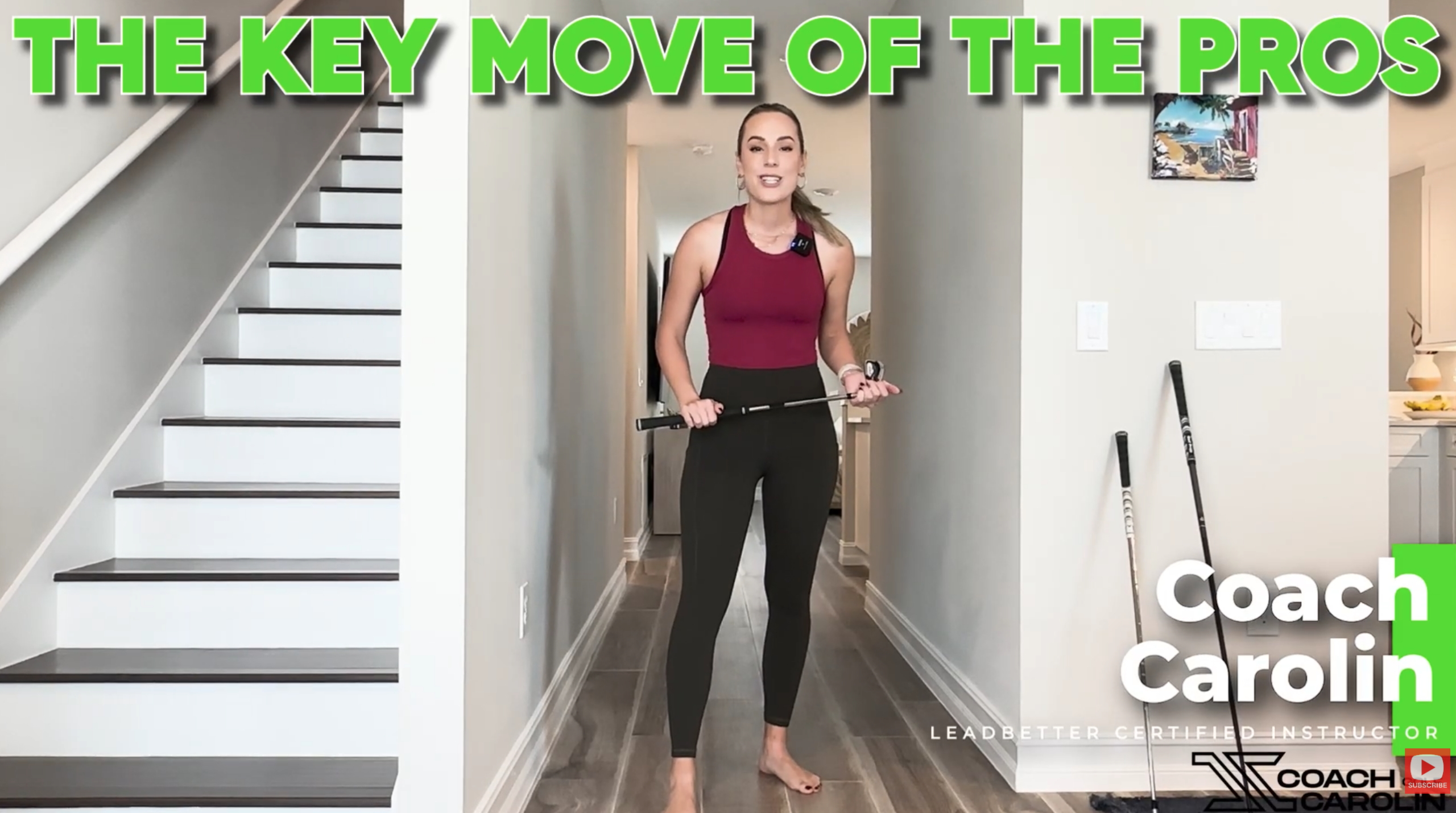
The Problem: You’ve watched tour highlights and noticed something weird. Their heads actually drop down through impact. And your brain screams, “That’s how you skull it!” So you either avoid the move entirely — losing power — or copy it and chunk three shots in a row.
This is one of the most misunderstood moves in golf, and a recent “Hallway Golf” tip from Coach Carolin breaks it down in about four minutes. Here’s what she actually says — and how to use it.
The Move That Looks Like a Recipe for Disaster
Watch any PGA or LPGA broadcast in slow motion and you’ll spot it: at the start of the downswing, the player’s head drops. They almost squat into the ground. They lose height to the turf.
Most amateurs see that and think the obvious thing: “If I get closer to the ground, I’m hitting ground before ball.”
Coach Carolin gets it. Her words: “That doesn’t make any sense — how can we go closer to the ground without actually hitting the ground?”
She’s not dismissing the fear. She’s saying there is a missing variable, and until you see it, the move will always look terrifying.
The Missing Variable: Forward Press + Rotation
Here is the actual concept from the video, and it clicks instantly once you see it.
Take a club and hold it out in front of you at setup. There’s a certain distance between your chest and the clubhead.
Now push your hands forward without moving your chest.
Watch what happens to that distance. The clubhead gets closer to your chest. The shaft leans forward. You just “gained a foot” toward you — and you didn’t move your body up.
That is exactly what the pros are doing with their whole body through the downswing. They’re not just dipping their head — they’re rotating and pressing forward at the same time. The forward press eats up the space that the lower head position would otherwise waste.
This is why they don’t chunk it.
Setup vs. Impact Are NOT the Same Position
This is the part most amateurs get catastrophically wrong.
You set up to the ball with the shaft roughly neutral or slightly forward. Then your brain assumes impact should look the same. So you stay up, stay tall, and try to swing level.
Coach Carolin’s point — and this is the unlock — is that impact should not mirror setup.
Through impact:
- Your hands have pressed forward (forward shaft lean)
- Your trail arm has tucked and bent
- Your chest has rotated toward the target
- And yes, your head has dipped
That is real impact. Especially with an iron. And honestly, even with the driver — same idea.
If you’ve ever pressed against an impact bag, you’ve felt this. The bag forces your hands forward, your trail arm folds, your chest turns. The head drops naturally because the whole pattern drops together — but the hands got ahead of the clubhead first, so the clubhead still arrives at the ball after the lowest point of the swing arc has already passed.
That’s why ball-first contact is possible even with a dipped head.
The Opposite Mistake: Standing Up to “Save” It
Here’s where amateurs panic in the other direction.
Feeling that head dip coming, they do the opposite — they stand up and extend out of the shot to “clear” the turf. Coach Carolin flags this clearly: “There’s different reasons usually — that’s because they need to shallow the club.”
And she’s right that standing up does technically shallow the shaft. But shallowing isn’t your problem — early extension is. Standing up costs you:
- Power (you lose the ground you pressed into)
- Consistency (your low point moves around)
- Compression (no more ball-then-turf strikes)
The fix isn’t to extend up. The fix is to let the head dip and keep your angles intact.
The Actionable Takeaways
If you want to actually use this on the range tomorrow, here’s the short list:
- Press forward with the hands. At setup, feel a little forward shaft lean — like the club is already slightly leaning toward the target. This is your new “neutral.”
- Rotate, don’t lift. Through impact, your chest should be turning toward the target. Your head drops with the rotation, not because you’re crouching.
- Keep your spine angle. The thing you don’t want to lose is your tilt — the angle between your spine and the ground. Keep that. Lose height from the head, not the spine.
- Trust the trail arm tuck. Let your right arm bend and fold through impact. Stop trying to hold it straight. That fold is part of what creates the forward press automatically.
- Stop standing up. If you feel yourself extending out of posture to “save” a thin shot, you just lost the entire move. Stand up once after impact — never during.
Drill it slowly first. Half-swings where you stop at impact and check: shaft forward? Head lower than at setup? Trail arm bent? Chest pointed at the ball or past it? If yes, you’ve got the pattern.
Why This Is So Often Missed
Coach Carolin closes the video on an honest note — she says this concept “is not widely understood, but once you have understood it, it’s really easy to kind of start getting those feelings down.”
That’s the truth with most of golf. The pro move looks scary in isolation. It only makes sense once you see the whole system rotating and pressing together, with the setup and impact being two different shapes instead of one shape repeated.
Once you feel that forward press with a dipped head and a rotated chest — even once — you’ll stop fighting the move and start using it.
Watch the Full Breakdown
Coach Carolin walks through it on camera in under five minutes, with a clear visual of hands-forward vs. setup to anchor the concept. Worth a rewatch before your next range session:
Hit ’em ball-first. Then turf. The head can drop — as long as the hands got there first.
Drop your results in the comments. Did the forward press cue fix your chunk, or are you still standing up out of it?