

Have you ever walked up to your ball near a stake and paused, wondering, “Wait… is this a free drop or a penalty drop?” You’re not alone. Understanding what each colored stake means can save you strokes and confusion during your round.
Let’s break them down so you can play confidently without second-guessing your options.
White stakes: Out of bounds

What it is:
White stakes mark the out of bounds (OB) areas. If your ball ends up beyond these stakes, it’s considered out of play.
What happens:
You must take stroke-and-distance relief, meaning you add one penalty stroke and replay the shot from the original spot. Unfortunately, you cannot drop near where the ball went OB (unless playing under a local rule for pace of play allowing a drop with penalty near the OB line).
Why it matters:
OB is one of the most punishing penalties in golf, so if you see white stakes running along a hole, consider clubbing down or aiming away from them to keep your ball in play.
Red stakes: Lateral penalty area

What it is:
Red stakes mark a lateral penalty area, usually a hazard running alongside the hole like a creek, pond edge, or thick brush where playing the ball is unlikely.
What happens:
You have options, each with a one-stroke penalty:
- Replay from the original spot.
- Drop within two club lengths of where the ball last crossed the hazard’s edge, no closer to the hole.
Why it matters:
Red stakes provide lateral relief, making it easier to continue without backtracking too far. Always check your two-club-length drop carefully to avoid dropping closer to the hole.
Yellow stakes: Penalty area
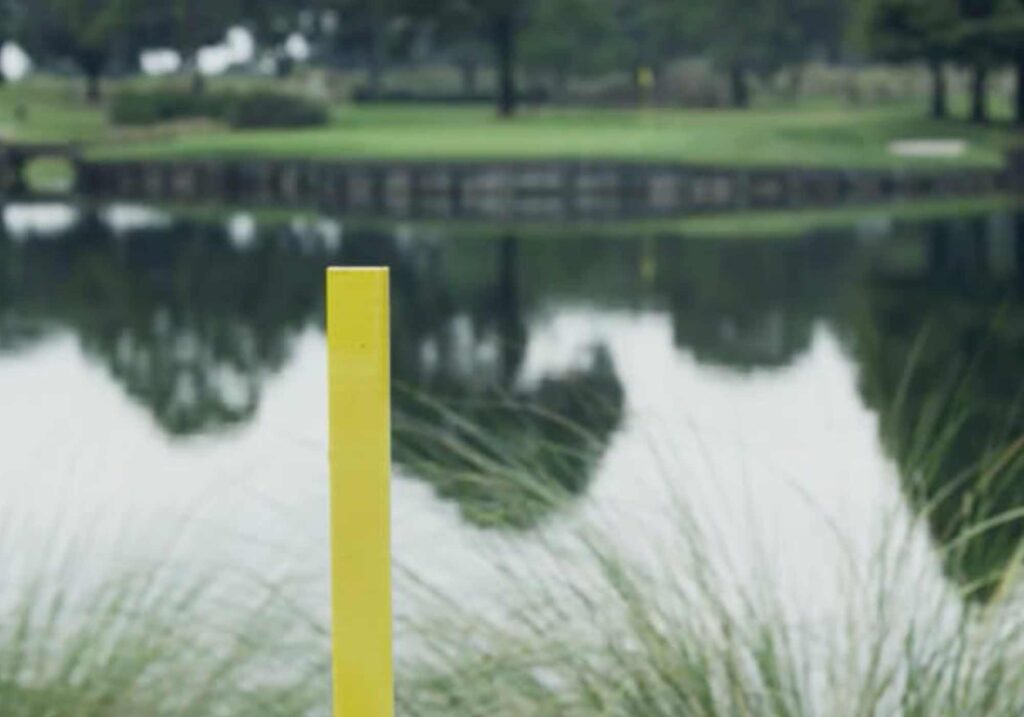
What it is:
Yellow stakes indicate a penalty area (traditionally called a water hazard) directly crossing your line of play, like a pond or ditch you’re hitting over.
What happens:
Your options, each with a one-stroke penalty:
- Replay from the original spot.
- Drop behind the hazard on a straight line from the hole through the point where the ball last crossed the hazard, going back as far as you want.
Why it matters:
Unlike red stakes, yellow stakes don’t offer lateral relief. They are more restrictive, often forcing a replay or a drop far back, so knowing the difference prevents incorrect drops and extra penalties.
Blue stakes: Ground under repair (sometimes)

What it is:
Blue stakes (or sometimes blue lines or roped areas) commonly designate ground under repair (GUR) or environmentally sensitive areas. However, blue stakes usage can vary by course.
What happens:
If marked as GUR, you get free relief by finding the nearest point of relief no closer to the hole and dropping within one club length.
Why it matters:
It protects the course from unnecessary damage and ensures fair play when areas are unfit. Always confirm with local rules or course signage as blue stakes might also be used for other designations at certain clubs.
Additional stake colors you might see
- Green stakes: Occasionally used to mark environmentally sensitive areas (ESA) where entry is prohibited. Relief rules are course-specific, so check the local rule card.
- Black and white striped stakes: Often used to indicate distance markers, like 150 yards to the center of the green, rather than defining hazards or boundaries.
Key takeaway: Know before you drop
The next time you spot stakes around the course, take a moment to confirm their color and meaning. Incorrect drops can lead to penalty strokes or disqualification in tournaments. Here’s a quick recap:
White: Out of bounds – stroke and distance
Red: Lateral penalty area – drop with penalty, two club lengths or replay
Yellow: Penalty area – drop with penalty behind the hazard or replay
Blue: Ground under repair – free relief, confirm local rules
Green/Other: Course-specific, check signage
Final thoughts
Understanding these colored stakes isn’t just about following the rules – it’s about playing smarter golf. Knowing your options can turn a penalty situation into an opportunity to save par or avoid a big number. Next round, take a mental note of stake placements off each tee and around greens. You’ll feel more confident, and your scorecard will thank you.
Have you ever taken the wrong drop because of stake confusion? Share your story or questions in the comments below – let’s keep each other playing smart golf.
FAQ: Golf stakes and rules
Q: What happens if I hit my ball near a stake but I’m unsure what it marks?
A: Always check your scorecard or ask the pro shop before teeing off. Many courses list local rules and stake meanings, as some colors (like blue or green) can vary in purpose.
Q: Can I stand out of bounds to hit a ball that’s in bounds?
A: Yes. The Rules of Golf allow you to stand out of bounds as long as your ball is in play within the boundary line.
Q: What if I accidentally move a stake while searching for my ball?
A: If the stake is movable (like a distance marker stake), you can replace it without penalty. But if it’s a boundary stake (white) or permanent penalty area stake, it should not be moved. Consult local rules to be safe.
Q: Are all red and yellow stakes hazards?
A: Technically, under the Rules of Golf, they are now called penalty areas rather than hazards. But yes, both indicate areas where you’ll take a penalty stroke if relief is needed.
Q: Do courses ever change stake colors for tournaments?
A: Occasionally, yes. Tournament committees may re-stake areas to alter playability or clarify boundaries for competition. Always read the tournament rules sheet before your round.
1 Comment
Worthless article. There are two additional options for playing a ball in a Red Penalty area.
– Back of line relief with one penalty stroke
– Play the ball as it lies with no penalty