
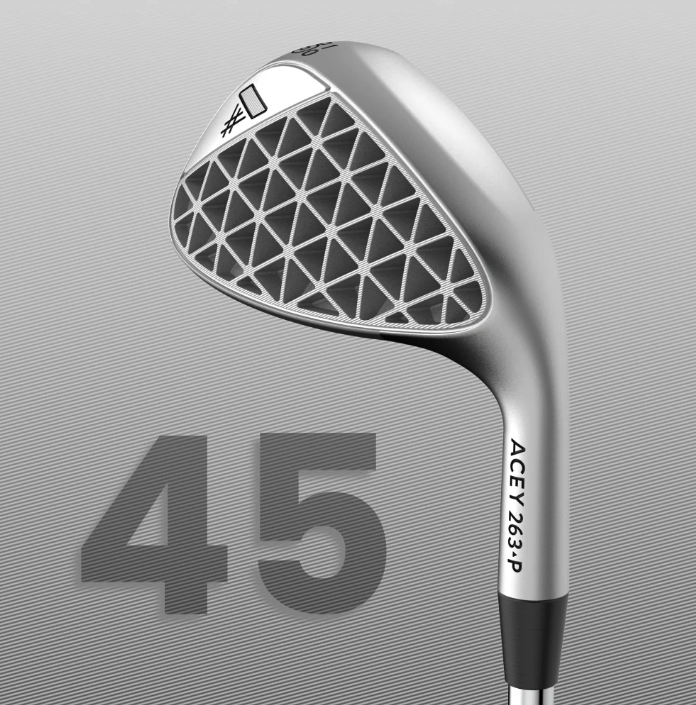
A Jacksonville startup is printing wedges out of stainless steel and charging $300 apiece. A first look at the design, the designer behind it and what the early testing actually shows.
The Problem: Great Drive, Terrible Wedge
You know the hole. You split the fairway, you’ve got 118 yards in, and you’re already thinking birdie. Then the wedge comes up fat, or thin, or ten yards long, and you’re chipping back up a slope to a pin tucked four paces from the edge.
Most golfers don’t lose strokes because they can’t hit the ball. They lose them because their misses cluster in the wrong place. A wedge that flies its number and holds its line on a slightly thin strike is worth more than one that feels like butter twice a round when you pure it.
That’s the gap Acey Golf is selling into. Their wedge, the 263, is 3D-printed from stainless steel, costs $300, and comes with a pitch blunt enough to be refreshing: “You wouldn’t play a driver designed in 1930. Why do that with wedges?”
Fair question. And an expensive one to answer, because at $300 a club you want more than a marketing page before you commit.
So here is what this piece is. It’s a first look, not a hands-on test. We haven’t put the 263 in the bag yet; when we do, this article gets updated and says so at the top. What follows is everything that can be established without swinging it: what the 263 actually is, who designed it, what the independent testing has found, and whether the price makes sense for the way you play. Reporting, in other words, rather than a verdict from the range.
What the Acey 263 Actually Is
The headline number is the price. $300 for a single wedge is a lot of money, and Acey says so themselves rather than pretending otherwise. But this isn’t a mass-produced club with a premium badge bolted on. It’s a small-batch part, printed individually and assembled by a very small company in Jacksonville, Florida.
The second headline is the back of the club. Where a normal wedge has a solid muscle or a milled cavity, the 263 has an open triangular lattice. It isn’t a cover or a badge. It’s the actual structure of the head, printed as one piece with the face, hosel and sole. Acey calls it a “crown” surface, borrowing the idea from drivers and hybrids, and says it stiffens the head and improves feel.
From address, though, you’d never know any of that. The topline, leading edge and offset are conventional. The profile is slightly larger than a blade, roughly cavity-back territory. That’s deliberate, and it’s the smartest decision in the whole design: the club looks wild in the bag and completely normal over the ball.
The Pedigree Is Real
The fair question about any new golf brand is whether there’s a designer behind it, or just a guy with a printer and a logo.
Andy Chick spent years in club design before starting Acey. He was industrial design lead on the Cleveland CG14 wedge, the one Tim Clark used to win the 2010 Players Championship. He later worked on Nike’s Engage wedges and Vapor Pro Combo irons, including versions that turned up in major winners’ bags. He also spent time at HP during the period when metal additive manufacturing was being explored in partnership with golf companies.
He’ll tell you the 263 took hundreds of prototypes, and that the first version he was happy with wasn’t the first version he printed. Earlier concepts, the 261 and several 262s, explored cast and two-piece forged construction before the printed design won out. That isn’t the profile of a vapourware brand.
Why Print It Instead of Cast It
This is where the lattice stops being a look and starts being a decision.
Casting and forging constrain you. You can’t easily hollow out the back of a wedge and leave a load-bearing skeleton behind, because the mould or the die won’t do it. Additive manufacturing will. Acey uses that freedom to pull mass off the middle of the back of the head and push it toward the perimeter, which raises stability without adding bulk, and keeps the face thin, at roughly 2.5mm, with the lattice running through the structure behind it.
Acey also made a deliberately unfashionable call on the sole: one perimeter-relief design across all four lofts, with relief in the heel, toe and trailing edge, instead of the six-grind menus the big brands offer.
That’s opinionated, and worth knowing before you buy. Andy’s argument is that grind variety has become partly a manufacturing-flexibility story rather than something the average player genuinely benefits from. There’s a fair counterargument, because a shallow player on firm links turf really does want different bounce than a steep player in soft parkland. But if you’ve never been fitted for a grind and couldn’t tell anyone your bounce number, Acey’s approach is honest and probably more than enough.
What the Independent Testing Shows
Acey sent early sets to reviewers, and The Hackers Paradise put the 45° and 55° through on-course and SkyTrak Max testing. What they found is the most useful part of this whole story.
The 45° carried about 120 yards on full swings, with high launch and moderate spin. That’s pitching-wedge behaviour, not blade behaviour. The 55° carried 100 to 105, also high-launching, with spin lower than a traditional blade wedge. Distance consistency was excellent in both, toe strikes kept their speed, and low-face contact was reasonably protected.
On the course, the wide sole didn’t dig on tight, wet turf. And the detail that matters most: the face opened up easily without the leading edge climbing halfway up the ball.
That last point is the real sell. Plenty of forgiving wedges are forgiving because they’re wide and blunt and refuse to be opened. The 263’s trailing-edge relief means you can still hit the high, soft one when the pin is four paces from the edge. Forgiveness without giving up the shot you actually need.
Two quirks worth knowing about. The lattice whistles on a full swing, loud enough to be unsettling at first, though testers said they got used to it. And it collects grass and dirt, so it wants a rinse after most rounds. Neither is a dealbreaker. Both are the cost of the design.
The Catches
$300 per wedge. If you play 45, 50, 55 and 60, that’s $1,200. The head-only option helps if you already have .355 taper-tip shafts and a builder you trust, but it doesn’t make the club cheap.
Lower spin than a blade. For most mid and high handicappers that’s fine, because spin consistency matters more than peak spin, and a high-spin wedge in inconsistent hands mostly produces inconsistent results. But if you rely on checking the ball with a 60°, this is a test-before-you-buy situation rather than an order-online one.
One sole, one bounce. Ten degrees across the lineup, plus whatever you get from manipulating the face. If your home course is baked hardpan, or you’re a shallow player who needs low bounce, be honest with yourself about that.
Six to eight weeks. Small batches, small company, free domestic shipping. This isn’t a club you’ll have for next weekend.
Who Should Buy It
Buy it if you’re a mid-handicapper whose wedge misses are distance misses rather than strike-quality misses, you already play cavity-back irons and never loved how a blade wedge punished you, and you want one wedge you can chip with, pitch with and open up in a bunker without a grind PhD.
Skip it if you need maximum spin, you have a specific bounce and grind requirement, or $300 is your entire wedge budget. In that last case, buy a used wedge from a major brand and a short-game lesson. You’ll score better, and it isn’t close.
The Verdict
The Acey 263 is a real golf club made by someone who knows how to make golf clubs, and the 3D printing is a means rather than a gimmick. But be clear about what you’re paying for. The printing doesn’t send the ball somewhere a cast wedge can’t reach. It buys Acey the freedom to build a more stable head that still looks and plays like a wedge at address.
That’s a genuine improvement, and a modest one. You’re paying a premium for a small-batch American-made club with real engineering behind it, plus a stability gain you’ll notice most on the shots you’d otherwise write off.
If you have $300 and a wedge slot you’ve never been happy with, it deserves a serious look. If you were hoping 3D printing would fix your short game, save the money and go practise your chipping. No club has ever fixed that.
Acey 263: The Numbers
Specifications as published by Acey Golf and reported in independent testing.
| Spec | Acey 263 |
|---|---|
| Lofts | 45°, 50°, 55°, 60° |
| Bounce | 10° (all lofts) |
| Construction | 3D-printed 316L stainless steel, one piece |
| Face | Roughly 2.5mm, face-centred sweet spot |
| Sole | Perimeter relief: heel, toe and trailing edge |
| Swing weight | D3 (45° and 50°), D5 (55° and 60°) |
| Stock shaft | True Temper Dynamic Gold S300 |
| Stock grip | True Temper ICON |
| Finishes | Satin, Raw, Copper, Gunmetal |
| Price | $300 assembled; head-only option available |
| Conformity | Listed as conforming by the USGA |
| Built in | Designed and assembled in Jacksonville, Florida |
| Shipping | Free domestic, most orders in 6–8 weeks |